On June 12, 2026, SpaceX rang the Nasdaq bell under ticker SPCX, priced its IPO at $135 a share, opened at $160.95, and closed its first session at $161 — a 19.2% pop on the largest stock-market debut in history. That single trading day did something no human being had ever done: it pushed Elon Musk past a $1 trillion personal fortune. By the time markets closed, every major tracker — Forbes, Bloomberg, and Visual Capitalist — was reporting the same headline: the world’s first trillionaire was no longer a forecast. He was a fact.
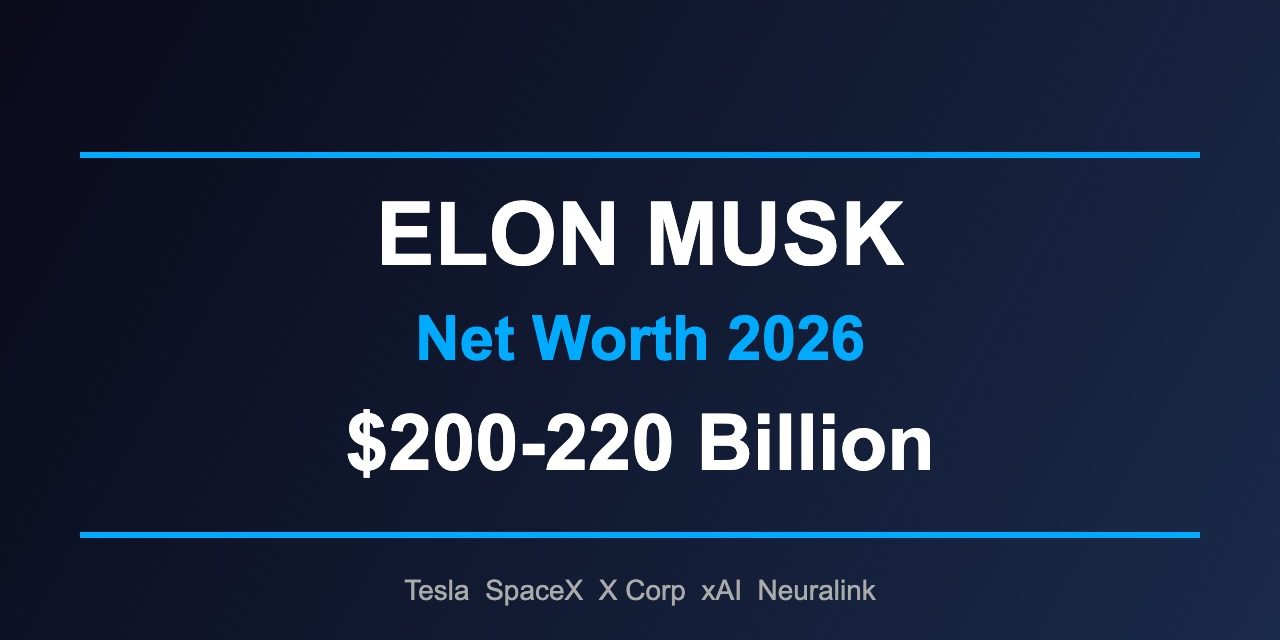
As of June 2026, Musk’s net worth sits at roughly $1.5 trillion. His SpaceX stake alone is worth somewhere between $400 billion and $500 billion at the post-IPO trading price near $185, and that is on top of a Tesla position worth more than $400 billion, his xAI stake, his X (formerly Twitter) equity, Neuralink, and The Boring Company. Most of that money is locked up — SpaceX shares are under a 12-month post-IPO lockup until mid-2027 — but on paper, he is the wealthiest individual ever recorded.
This article goes deeper than a number. Below we trace every school he attended, the first company he ever sold, the friends and rivals in his inner circle, the first house he bought, the games he plays to switch his brain off, the venture capitalists who wrote the cheques nobody else would, and a full year-by-year timeline from a Pretoria hospital ward in 1971 to a $1.77 trillion IPO in 2026.
Walk Through the Article
How Did Elon Musk Make His Money?
Musk’s trillion-dollar fortune is not a single bet. It’s a portfolio of six companies that he founded, co-founded, or rescued, plus a stake in artificial intelligence that didn’t exist five years ago.
- SpaceX — founded March 14, 2002. After the historic June 2026 IPO, SpaceX trades at a market capitalization above $2 trillion. Musk owned roughly 42% of SpaceX going into the IPO; his post-listing stake is the single biggest line on his personal balance sheet.
- Tesla — joined as chairman in April 2004 with a $6.35 million cheque that funded almost the entire $6.5 million Series A. He became CEO in October 2008. Tesla shares still account for roughly $400 billion of his fortune.
- xAI — founded July 2023. The chatbot Grok runs on it; the company merged with X in March 2025 in an all-stock deal that valued the combined entity at $113 billion.
- X (formerly Twitter) — bought for $44 billion in October 2022. Renamed in July 2023. His personal stake is now wrapped inside the xAI–X merger.
- Neuralink — founded 2016. The brain–computer interface company is now worth around $9 billion based on its latest private round.
- The Boring Company — founded 2017. A tunnelling business currently valued at about $7 billion privately.
For comparison, Mark Zuckerberg’s $230 billion Meta fortune would have to multiply more than six times over to reach Musk’s current paper value.
From Pretoria to Penn: Every School Elon Musk Ever Attended
Musk’s education trail is a list of seven institutions across three countries — and he dropped out of the last one after about two days. The path tells you a lot about how he thinks: he treated every school as a runway and bailed the moment the runway ended.
Waterkloof House Preparatory School (Pretoria, ages ~6–11)
Musk’s first formal schooling was at Waterkloof House Preparatory in suburban Pretoria, one of the older private prep schools in South Africa. By age 10 he had a Commodore VIC-20 at home and was teaching himself BASIC programming from the manual. At 12 he wrote a simple shoot-em-up called Blastar and sold it to a South African computing magazine, PC and Office Technology, for the equivalent of about $500 — his first commercial software sale.
Bryanston High School (Johannesburg, early teens)
Bryanston is the school where the famous bullying happened. Walter Isaacson’s 2023 biography describes a group of boys cornering Musk on a staircase, pushing him down, and beating him so badly that he spent a week in hospital. He has said the experience shaped his tolerance for pain and his willingness to take fights to extremes. He transferred out.
Pretoria Boys High School (graduated 1988)
Pretoria Boys High is where Musk graduated. It is a publicly funded, English-medium boys’ school founded in 1901 with an academic culture that has produced several South African Rhodes Scholars. Musk was an above-average but not top student — his standardised test scores in maths and computer science were exceptional, his liberal-arts marks ordinary.
University of Pretoria (5 months in 1989)
Musk briefly studied at the University of Pretoria after high school. He stayed only about five months — long enough to avoid the South African Defence Force’s compulsory military service, which he was determined not to do, before leaving for Canada in 1989 on a Canadian passport (his mother Maye was Canadian-born).
Queen’s University, Kingston, Ontario (1990–92)
From 1990 to 1992, Musk studied business and economics at Queen’s University in Kingston, Ontario. He has said the Queen’s years were less about coursework and more about getting close enough to the American Ivy League to transfer in. Queen’s is also where he met Justine Wilson, then a freshman writer. According to her own 2010 Marie Claire essay, he intercepted her on the steps of her dorm and bluffed that they’d met at a party (they hadn’t). They began dating, married in 2000, and divorced in 2008.
University of Pennsylvania (1992–95)
Musk transferred to Penn in 1992 and earned two undergraduate degrees there: a Bachelor of Arts in Physics from the College of Arts and Sciences and a Bachelor of Science in Economics from the Wharton School. He has said that Wharton taught him how to read a balance sheet and that Physics taught him how to think from first principles — the framework he still uses to explain everything from rocket fuel chemistry to Tesla’s gigafactory cost curves.
Stanford University (two days in 1995)
Musk enrolled in a PhD program in applied physics and materials science at Stanford in the autumn of 1995. He dropped out after about two days to start Zip2 with his younger brother Kimbal. He has said he asked the head of the department for a leave of absence rather than a formal withdrawal and that, in theory, his place is still being held open. He has never returned.
Zip2: The First Company That Made Elon Musk a Multimillionaire
Musk’s first company is the one almost nobody talks about anymore, even though it is the cheque that paid for everything else.
Zip2 Corporation was incorporated as Global Link Information Network, Inc. on November 9, 1995 in Palo Alto, California by three people: Elon Musk, his brother Kimbal Musk, and a Canadian businessman named Greg Kouri who had been an early mentor to Elon in Toronto. Kouri contributed the initial $6,000 of seed capital that paid the rent on the brothers’ first office — a one-room space on University Avenue in Palo Alto where Elon and Kimbal famously slept on the floor and showered at the YMCA.
The product was a searchable online business directory paired with mapping. Newspapers including The New York Times, the Chicago Tribune, and Knight-Ridder licensed Zip2’s software to build their own city guides — the late-1990s equivalent of giving every regional paper a Yelp. Mohr Davidow Ventures led the first institutional round in 1996, putting in $3 million for about 60% of the company and replacing Elon as CEO with a professional manager named Rich Sorkin.
In February 1999, Compaq Computer’s AltaVista division bought Zip2 in an all-cash deal valued at $305 million (some accounts put the figure at $307 million including assumed liabilities). Elon’s personal cut was approximately $22 million. He was 27. Kimbal received around $15 million. Greg Kouri got back something around $6 million from his original $6,000.
Most newly minted twenty-something millionaires would have bought a yacht. Elon put almost all of it into his next company.
The Inner Circle: Musk’s Closest Friends, Rivals, and Co-Conspirators
If you ask Musk himself who he is closest to, the answer changes by year, by feud, and by Twitter thread. But across two decades there are recurring names — the people who lent him money when nobody else would, the people he poached employees from, and the people whose marriages got tangled up with his social life.
The PayPal Mafia
The “PayPal Mafia” is the loose label for the alumni of X.com/PayPal who went on to found or fund most of the modern internet. The recognisable core includes:
- Peter Thiel — Musk’s frenemy. They merged X.com and Confinity in March 2000 to create what would become PayPal. Thiel later ousted Musk as CEO while Musk was on his honeymoon. They reconciled when Thiel’s Founders Fund became one of the biggest early backers of SpaceX.
- Reid Hoffman — Co-founded LinkedIn after PayPal. Politically the liberal foil to the increasingly Republican wing of the mafia (Musk, Thiel, Sacks).
- David Sacks — PayPal’s first COO. Now closer to Musk than anyone else in the group; appointed AI and crypto czar in the second Trump administration.
- Max Levchin — Co-founded PayPal; later founded Yelp and Affirm.
- Ken Howery — Co-founded Founders Fund with Thiel; close to Musk through their joint Tesla and SpaceX investments.
- Roelof Botha — Former PayPal CFO who rose to lead Sequoia Capital, where he wrote some of the biggest cheques into SpaceX.
Larry Page (the broken friendship)
For most of the 2010s, Musk crashed at Google co-founder Larry Page‘s Palo Alto house whenever he was in Silicon Valley. They appeared together on Fortune‘s list of unlikely best-friend pairs. The relationship broke at Musk’s 44th birthday party in 2015 when Page reportedly called him a “speciesist” for prioritising humans over future digital intelligence. Musk’s poaching of Google AI researcher Ilya Sutskever to OpenAI finished it off. They have not been close since.
Sergey Brin
The other Google co-founder. Once part of Musk’s regular Silicon Valley dinner circuit. Their friendship was thrown into public chaos in 2022 when The Wall Street Journal reported Musk had had a brief affair with Brin’s then-wife Nicole Shanahan at an Art Basel Miami event in December 2021. Musk denied the romantic element; Shanahan and Brin had already separated by the time the story broke.
Antonio Gracias (the actual best friend)
If you had to name the single person Musk turns to first, most insiders point to Antonio Gracias, founder of Chicago-based private equity firm Valor Equity Partners. Gracias famously lent Musk $1 million personally in 2008 when Tesla was hours from bankruptcy. He served on Tesla’s board from 2007 to 2021 and on SpaceX’s board through to the IPO. After the SpaceX IPO, Gracias’s personal stake is reportedly worth somewhere between $90 billion and $100 billion — making him a billionaire on the back of his friendship with Musk.
Larry Ellison
The Oracle co-founder is a Tesla board member (2018–2022) and a long-running mentor figure. Ellison and Musk are neighbours in Lanai, Hawaii — Ellison owns roughly 98% of the island — and Ellison was an early personal backer of the Tesla–Twitter deal financing.
Justine Wilson
Musk’s first wife. They met at Queen’s University, married in 2000, and had six children together (the first, Nevada, died of SIDS at 10 weeks; surviving children are twins Vivian and Griffin, and triplets Kai, Saxon, and Damian). They divorced in 2008 in what Justine described in a 2010 essay as a painful imbalance of power.
Elon Musk’s First House: The Bel Air Mansion
For a man worth a trillion dollars, Musk’s housing trajectory is unexpectedly weird — it ends in a 400-square-foot rental.
His first significant property was a Bel Air mansion in Los Angeles that he initially rented in 2010 before deciding to buy it. The seven-bedroom, 20,200-square-foot estate sat on 1.67 acres overlooking the Bel Air Country Club. It included a two-storey library, a private screening room, a two-room guest suite, a 1,000-bottle wine cellar, a championship-sized lighted tennis court, a swimming pool, a fruit orchard, and a five-car garage. Musk bought it for $17 million in 2012.
Over the next decade he assembled six adjacent Bel Air properties at a combined cost of around $72 million, creating a quietly amassed mini-compound. Then in 2020 he announced on Twitter that he was selling “almost all physical possessions” and listing all of them. The original Bel Air mansion sold for $29 million in 2021 — a $12 million gain in nine years.
His current primary residence, since 2021, is a roughly $50,000 prefabricated 400-square-foot Boxabl Casita rented from SpaceX at the Starbase facility in Boca Chica, Texas. He has called it “kinda awesome” and pointed out that the rent is just enough to keep the IRS happy about taxable housing benefit. It is the cheapest first-tier billionaire residence on the planet.
Sports, Hobbies and What Musk Does for Fun
Musk has been remarkably consistent about how he switches his brain off: he plays video games. He told Lex Fridman on the podcast in 2023 that gaming is his “primary recreational activity” and that “killing the demons in a video game calms the demons in my mind.”
The specific games he plays, in his own words:
- Polytopia — the mobile civilisation strategy game he has called the one that taught him “empathy is not an asset” because aggressive expansion always wins.
- Deus Ex — the original 2000 immersive sim. He has called it the single best game ever made.
- Half-Life 2 — the Valve shooter from 2004.
- BioShock — the 2007 underwater dystopia.
- Mass Effect 2 — the 2010 BioWare RPG.
- Fallout 3 and Fallout: New Vegas — the Bethesda and Obsidian post-apocalyptic RPGs.
- Saints Row 4 — the 2013 open-world game.
- Diablo IV and Elden Ring — more recently, he has been ranked in the global top 20 for Diablo IV’s hardest difficulty and has streamed both on X.
Outside gaming, Musk has described himself as a “certified bookworm” who credits Douglas Adams’s The Hitchhiker’s Guide to the Galaxy with shaping how he frames problems (“the hardest part is knowing what question to ask”). He has cited Isaac Asimov’s Foundation series as the intellectual seed of his interest in extending human civilisation beyond Earth.
Traditional sports do not feature heavily. He has practised judo and Brazilian jiu-jitsu at various points, and famously challenged Mark Zuckerberg to a cage fight in 2023 that never happened. He does not golf. He does not surf. He has said he sleeps about six hours, often on a couch in a factory.
Who Backed Musk’s Companies? The Co-Investors Behind the Trillion
Musk’s reputation as a lone genius obscures the most important truth of his career: at every key moment, a small group of venture capitalists wrote the cheque that nobody else would.
Tesla early investors
Musk himself was the biggest early backer of Tesla. He put $6.35 million into the company’s $6.5 million Series A in April 2004 — about 98% of the round. Over the following four years, through Series B, C, and D, he kept signing cheques, eventually contributing more than $70 million of his own money. The other early Tesla institutions:
- Valor Equity Partners (Antonio Gracias) — first invested in Tesla in 2006, kept investing through 2010. Gracias’s board seat ran from 2007 to 2021.
- Draper Fisher Jurvetson (Steve Jurvetson) — led the 2006 Series C.
- Technology Partners — led the 2007 Series D, which announced $45 million in funding.
- Sergey Brin and Larry Page personally invested in the 2007 round.
- Daimler took a 10% strategic stake in 2009 for $50 million, which is what kept Tesla solvent before its 2010 IPO.
SpaceX early investors
Musk personally funded the first three Falcon 1 launches — about $100 million of his Zip2 and PayPal cash. The first outside money came in 2008 after launch #4 finally reached orbit:
- Founders Fund (Peter Thiel’s firm) led a $20 million round in August 2008. Founders Fund partner Scott Nolan was a very early SpaceX employee before moving to the VC side.
- Valor Equity Partners followed with around $76 million during the financial crisis.
- Sequoia Capital entered later but has been one of the largest institutional holders heading into the IPO, alongside Founders Fund.
- Draper Fisher Jurvetson, Bank of America, and Fidelity joined later rounds.
X (Twitter) co-investors
The October 2022 Twitter takeover required Musk to raise about $13 billion in debt and bring in equity co-investors. The biggest names on the cap table:
- Sequoia Capital — $800 million
- Andreessen Horowitz (a16z) — $400 million
- Saudi Public Investment Fund — rolled over a roughly $1.9 billion existing stake
- Binance — $500 million
- Fidelity — $316 million
- Larry Ellison personally — $1 billion
- Qatar Investment Authority — $375 million
SpaceX: The IPO That Made Musk a Trillionaire
SpaceX filed publicly on April 11, 2026. The roadshow priced it at $135 a share for a $1.77 trillion valuation. On the morning of June 12, the stock opened at $150, traded as high as $172, and closed at $160.95 — up 19.2% on day one, the largest first-day pop ever for a top-ten US IPO. The company raised $75 billion in fresh capital, the biggest equity raise in market history.
The size of the IPO was justified by SpaceX’s underlying business. Starlink had 7+ million subscribers entering 2026 and was generating an estimated $14 billion in annualised revenue. Falcon 9 launched a record 144 times in 2025 and is on track for 170+ in 2026. Starship reached full reusability with the IFT-12 catch in February 2026. Dragon and Falcon Heavy continued to carry the bulk of US national security payloads under the National Security Space Launch contract.
Musk’s lockup runs until June 12, 2027. He cannot sell a single SpaceX share until then. The trillion is, today, paper.
Tesla: Still the Other Half of the Fortune
Tesla pioneered the modern electric-vehicle market. The Model S (2012), Model 3 (2017), Model Y (2020), Cybertruck (2023), and the next-generation Robotaxi unveiled in October 2024 all built on the original mission to “accelerate the world’s transition to sustainable energy.” Musk’s outstanding 2018 CEO pay package — the one ruled invalid by a Delaware court and re-approved by Tesla shareholders in 2024 — vested in waves that produced roughly $50 billion in options-based wealth, the second-largest single chunk of his fortune after SpaceX. The 2025 board reset relocated Tesla’s incorporation from Delaware to Texas in part to defuse further shareholder lawsuits.
X, xAI, Neuralink, and The Boring Company
Outside the two giants, Musk runs four more companies. X (the social network) merged with xAI in March 2025 in a deal that valued the combined entity at $113 billion and gave the AI lab access to the platform’s real-time data firehose. xAI’s flagship model Grok 4 launched in mid-2025, and the company has raised more than $20 billion in subsequent rounds. Neuralink received FDA Breakthrough designation in 2023, performed its first human implant in early 2024, and now has more than a dozen patients with motor-cortex implants. The Boring Company operates the Vegas Loop and is digging tunnels for cities including Nashville and Riyadh.
Personal Life and Family
Musk has been married three times — twice to British actress Talulah Riley between 2010 and 2016 in addition to his marriage to Justine Wilson. He has 14 acknowledged children with four different partners (Justine, musician Grimes, Neuralink executive Shivon Zilis, and conservative author Ashley St Clair). His mother Maye Musk remains one of the most photographed older models in the world. His brother Kimbal Musk runs a restaurant group and the Big Green nonprofit. His sister Tosca Musk founded Passionflix.
Full Timeline: Elon Musk Year by Year, 1971 → 2026
- 1971 — Born June 28 in Pretoria, South Africa, to Errol Musk (engineer) and Maye Musk (model and dietitian).
- 1981 — Receives a Commodore VIC-20 for his tenth birthday and teaches himself BASIC.
- 1983 — Writes Blastar, his first video game, at age 12 and sells it to PC and Office Technology magazine for ~$500.
- 1988 — Graduates from Pretoria Boys High School.
- 1989 — Briefly enrols at the University of Pretoria, then leaves South Africa for Canada on a Canadian passport via his mother’s citizenship.
- 1990 — Enrols at Queen’s University, Kingston, Ontario. Meets Justine Wilson on her dorm steps.
- 1992 — Transfers to the University of Pennsylvania.
- 1995 — Graduates from Penn with BA in Physics and BS in Economics from Wharton. Enrols at Stanford for an applied-physics PhD; drops out after two days. Co-founds Zip2 with brother Kimbal and Greg Kouri on November 9.
- 1999 — Compaq acquires Zip2 for $305 million in February. Musk’s cut: ~$22 million. He co-founds X.com, an online bank, in March.
- 2000 — X.com merges with Peter Thiel’s Confinity in March, forming what becomes PayPal. Musk marries Justine Wilson. Thiel ousts Musk as CEO while Musk is on honeymoon.
- 2002 — eBay buys PayPal for $1.5 billion in October. Musk’s cut: ~$175 million. He founds Space Exploration Technologies (SpaceX) on March 14. Becomes a US citizen.
- 2003 — Martin Eberhard and Marc Tarpenning incorporate Tesla Motors in July.
- 2004 — Musk leads Tesla’s $6.5 million Series A in April with a $6.35 million personal cheque and becomes chairman.
- 2006 — Tesla unveils the Roadster prototype; SpaceX attempts Falcon 1 flight 1 (fails).
- 2008 — Triple crisis year. Falcon 1 finally reaches orbit on the 4th attempt in September. Tesla nearly bankrupt; Musk pours in his last $20 million; Antonio Gracias lends him $1 million personally. NASA awards SpaceX a $1.6 billion COTS contract in December. Musk becomes Tesla CEO in October. Divorces Justine.
- 2010 — Tesla IPOs at $17/share in June. Marries Talulah Riley. Begins renting Bel Air mansion.
- 2012 — SpaceX Dragon docks with the ISS in May, the first commercial spacecraft to do so. Musk buys the Bel Air mansion for $17 million.
- 2015 — Co-founds OpenAI with Sam Altman in December. Friendship with Larry Page collapses at his birthday party.
- 2016 — Founds Neuralink. Founds The Boring Company.
- 2018 — Tesla CEO compensation package approved (later voided 2024, re-approved 2024). “Funding secured” tweet leads to $20 million SEC fine.
- 2020 — Crewed Dragon Demo-2 launches NASA astronauts in May, ending US dependence on Russian Soyuz. Has first child with Grimes.
- 2021 — Sells most LA properties including the Bel Air mansion ($29 million). Moves to Boca Chica, Texas, into the $50K Boxabl Casita.
- 2022 — Acquires Twitter for $44 billion in October. Closes the deal carrying a sink. Alleged Art Basel affair with Sergey Brin’s wife Nicole Shanahan reported.
- 2023 — Rebrands Twitter to X in July. Founds xAI in July. Walter Isaacson’s biography Elon Musk publishes in September.
- 2024 — Tesla shareholders re-approve the voided $56 billion pay package. Musk becomes the most prominent technology backer of Donald Trump’s 2024 presidential campaign.
- 2025 — xAI merges with X at a $113 billion combined valuation in March. Joins the second Trump administration as head of the Department of Government Efficiency (DOGE) in January. Leaves DOGE in late May after public falling-out with Trump over the budget.
- 2026 — SpaceX files to IPO in April. Lists on Nasdaq under SPCX on June 12 at $135/share; opens at $160.95. Musk’s paper net worth crosses $1 trillion. By June 19, with SPCX trading at $185, his net worth sits at approximately $1.5 trillion.
Elon Musk Net Worth Over Time
Musk’s wealth has compounded faster than any other individual in recorded history. Snapshots from major trackers:
- 1999: $22 million (after Zip2 sale)
- 2002: ~$180 million (after PayPal sale, post-tax)
- 2008: under $20 million (nearly bankrupted by Tesla + SpaceX)
- 2012: $2 billion (Forbes)
- 2017: $20 billion
- 2020: $115 billion (Tesla’s blowout year)
- 2021: $260 billion (passes Jeff Bezos as world’s richest)
- 2024: ~$400 billion
- June 2026: ~$1.5 trillion (SpaceX IPO trillionaire)
For context, see how the rest of the global rich list compares: Bill Gates ($115B), Warren Buffett ($135B), Mark Zuckerberg ($230B), Sergey Brin ($154B), and Sundar Pichai.
Frequently Asked Questions About Elon Musk
Is Elon Musk officially a trillionaire?
Yes. On June 12, 2026, SpaceX’s IPO closed at $160.95 a share for a $1.77 trillion company valuation. That valuation pushed Musk’s personal net worth above $1 trillion for the first time ever recorded — confirmed by Forbes, Bloomberg, and Visual Capitalist within hours of market close. By June 19 his net worth had risen further to approximately $1.5 trillion as SPCX traded up to $185.
Which school did Elon Musk graduate from?
Musk graduated from Pretoria Boys High School in Pretoria, South Africa in 1988 after transferring out of Bryanston High School following a severe bullying incident.
What was Elon Musk’s first company?
His first company was Zip2, an online business-directory and city-guide platform that he co-founded in November 1995 with his brother Kimbal Musk and Canadian businessman Greg Kouri. Compaq acquired Zip2 in February 1999 for $305 million. Musk’s personal cut was about $22 million.
Who is Elon Musk’s best friend?
Most insiders point to Antonio Gracias, founder of Valor Equity Partners. Gracias has backed every Musk company since 2006, lent Musk $1 million personally during Tesla’s 2008 crisis, and served on Tesla’s board for 14 years.
What was Elon Musk’s first house?
His first major property was a seven-bedroom Bel Air mansion in Los Angeles, which he initially rented in 2010 and bought outright in 2012 for $17 million. He sold it for $29 million in 2021.
Where does Elon Musk live now?
Since 2021, his primary residence is a ~$50,000 Boxabl Casita — a 400-square-foot prefabricated tiny home — rented from SpaceX at the Starbase facility in Boca Chica, Texas.
What is Elon Musk’s favourite hobby?
By his own admission, video games. He has called gaming his “primary recreational activity” and named Polytopia, Deus Ex, Half-Life 2, BioShock, Diablo IV, and Elden Ring among his favourites.
Who were Elon Musk’s biggest early investors?
For Tesla, the biggest non-Musk early backers were Valor Equity Partners (Antonio Gracias), Draper Fisher Jurvetson, Technology Partners, and Daimler. For SpaceX, the biggest were Founders Fund (Peter Thiel), Valor, Sequoia Capital, and Draper Fisher Jurvetson.
How many degrees does Elon Musk have?
Two undergraduate degrees, both from the University of Pennsylvania: a BA in Physics and a BS in Economics from the Wharton School. He briefly enrolled in a Stanford PhD program in 1995 but dropped out after about two days.
Has Elon Musk ever lost money?
Yes — most famously in 2008, when he sank his entire PayPal fortune into Tesla and SpaceX simultaneously and was personally borrowing to make rent. The triple-crisis year ended only when NASA awarded SpaceX a $1.6 billion COTS contract on December 23, 2008.