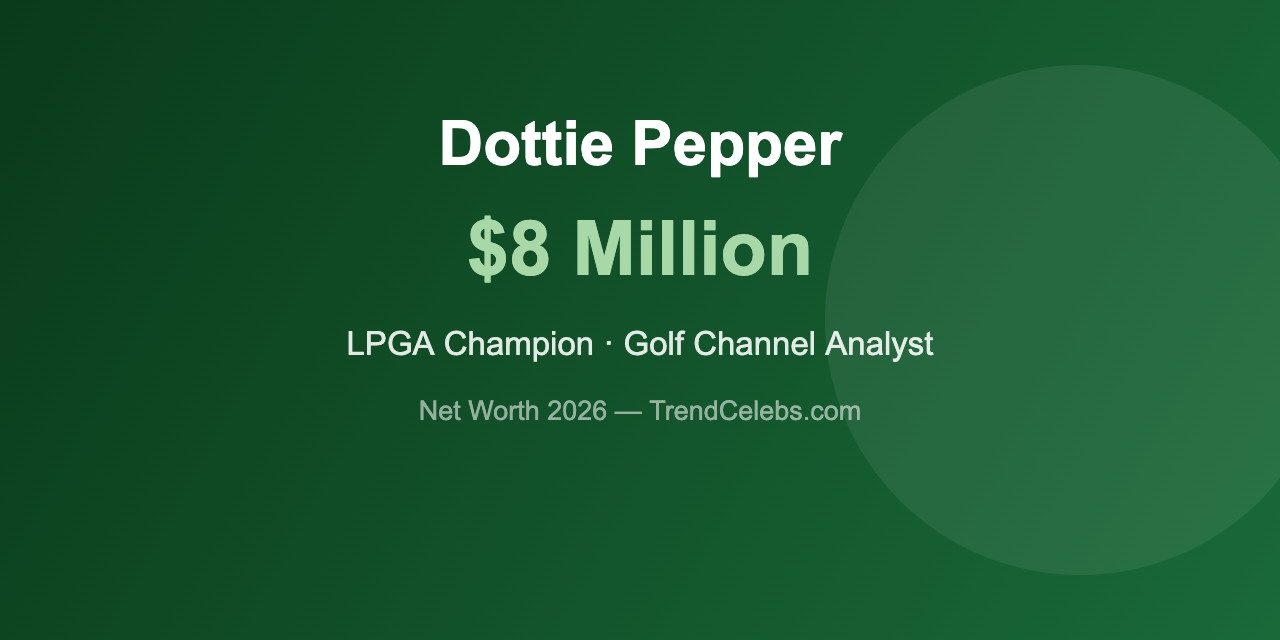
Dottie Pepper’s net worth is estimated at $8 million as of 2026, built through a Hall of Fame LPGA career featuring 17 wins and two major championships, followed by a successful second act as one of Golf Channel and CBS Sports’ most respected and outspoken analysts.
| Full Name | Dorothy Mary Pepper |
|---|---|
| Born | August 17, 1965 — Saratoga Springs, New York |
| Age | 60 years old |
| Profession | Golf Analyst, Former LPGA Professional |
| Net Worth | $8 Million (2026) |
| LPGA Wins | 17 (including 2 majors) |
| Known For | Golf Channel analyst, LPGA Hall of Famer, Solheim Cup record |

Walk Through the Article
Income Breakdown
| Source | Amount | Type | Notes |
|---|---|---|---|
| LPGA Tour career earnings | $6M+ cumulative | Cumulative | 17 wins, including Nabisco Dinah Shore (1992, 1999) and du Maurier Classic (1992) |
| CBS Sports/Golf Channel analysis | $500K-1M/year | Annual (personal) | Major championship coverage including US Open, Masters, Ryder Cup, Solheim Cup |
| Speaking & corporate appearances | $200-400K/year | Annual (personal) | Golf industry events, corporate outings, charity tournaments |
| Estimated Net Worth | $8 Million (2026) | ||
Career Overview
Dottie Pepper turned professional in 1987 after a distinguished amateur career at Furman University. She quickly established herself as one of the LPGA Tour’s most competitive players, winning 17 times including the Nabisco Dinah Shore (now the ANA Inspiration) in 1992 and 1999, and the du Maurier Classic in 1992. She was inducted into the World Golf Hall of Fame in 2004, cementing her status as one of her era’s defining players.
Her Solheim Cup record — the women’s team competition equivalent of the Ryder Cup — is the foundation of much of her legend. Pepper played with an intensity that polarised audiences but never failed to engage them. That competitive fire has translated directly into her broadcasting career, where she is known for forthright opinions and willingness to criticise players, officials, and course setups that she believes fall short of the required standard. Her CBS Sports and Golf Channel work covers major championships and the Solheim Cup.
Personal Life
Dottie Pepper has been married multiple times. Her personal life has been more private than her professional one, and she has spoken about the difficulty of maintaining relationships during the intensive LPGA Tour schedule. She remains based in the northeastern United States and is closely associated with the Saratoga Springs area where she grew up.
Lesser-Known Facts
- Dottie Pepper’s 1.3 record in Solheim Cup singles play (winning 13 of her 15 singles matches) is one of the most dominant individual records in the competition’s history.
- She was known during her playing career for an intensity and focus that opponents found intimidating — a reputation she has spoken about with some pride and some reflection in interviews since retiring.
- Her transition into broadcasting was not immediate after her playing career; she spent time as a teaching professional and consultant before joining Golf Channel’s on-air team.
- She has been consistently outspoken about women’s issues in golf, including equipment standards, course setups, and prize money equity between the LPGA and PGA Tours.
- Pepper was a standout collegiate golfer at Furman University in South Carolina, whose women’s golf programme has produced multiple LPGA Tour players.

Net Worth Over Time
Dottie Pepper’s $8 million net worth reflects the compound effect of a long LPGA career and a successful broadcasting second act. Her LPGA earnings exceeded $6 million over a 20-year professional career, supplemented by endorsements and corporate appearances during her playing years. The transition into broadcasting added a consistent salary income that has continued building her financial position well beyond the end of her competitive career.
What is Dottie Pepper’s net worth?
Dottie Pepper’s net worth is estimated at $8 million as of 2026, from her LPGA Tour career earnings ($6M+), CBS Sports and Golf Channel broadcasting salary, and corporate appearances.
How many times did Dottie Pepper win the Solheim Cup?
Dottie Pepper had one of the most impressive individual Solheim Cup records in the competition’s history, with a 13-4-1 record in singles play — a dominance that has never been matched in the competition.
Where is Dottie Pepper now?
As of 2026, Dottie Pepper works as a golf analyst for CBS Sports and Golf Channel, covering major championships and Solheim Cup events. She is one of women’s golf’s most respected broadcasting voices.
How many LPGA wins did Dottie Pepper have?
Dottie Pepper won 17 times on the LPGA Tour, including two major championships: the Nabisco Dinah Shore in 1992 and 1999, and the du Maurier Classic in 1992. She was inducted into the World Golf Hall of Fame in 2004.
Also Read:
Career Legacy and 2026 Outlook
Building a lasting career in professional golf broadcasting requires genuine playing expertise, communication skills developed across years of live television, and the personal presence to sustain viewer engagement across major championship coverage. The analysts who achieve this combination are among the sport’s most valuable personalities. In 2026, experienced golf broadcasting voices who have built genuine authority over years of coverage are among the sport’s most durable commercial assets — able to provide context, historical perspective, and technical depth that newer analysts cannot match. Their financial positions reflect that durable professional value.
Golf broadcasting in 2026 operates against a backdrop of significant structural change — the evolving PGA Tour/LIV Golf relationship, shifting broadcast rights, and changing audience behaviour across streaming and traditional television. Against this turbulence, voices with proven track records and established audience relationships are particularly valuable. The net worth figures associated with successful golf broadcasters represent not just accumulated wealth but the market’s assessment of their sustained relevance in a sport whose global audience continues to grow.
Dottie Pepper: What Makes a Great Golf Broadcaster?
Dottie Pepper brings to Golf Channel and CBS Sports a quality that distinguishes the truly elite golf broadcasters from the merely competent: genuine authority. Her 17 LPGA wins, her dominant Solheim Cup record, and her reputation for fierce competitive intensity give her opinions a weight that audiences and active players recognise immediately. When Pepper says a shot was poorly executed or a course setup unfair, the judgment carries the credibility of someone who played at the highest level under comparable pressure.
Her willingness to state those opinions directly — without the diplomatic softening that characterises many former player-broadcasters — has made her polarising in some quarters but deeply respected in others. In an era when golf broadcasting faces pressure to be both informative and inoffensive, Pepper’s commitment to honest analysis is a commercial differentiator that keeps audiences engaged even when they disagree with her specific conclusions.
Lesser-Known Facts About Dottie Pepper
- The transition from competitive golfer to broadcaster is far more difficult than it appears from the outside — the instincts that make a great competitor (intensity, focus on personal performance, suppression of uncertainty) actively work against the qualities that make a great broadcaster (empathy, accessibility, willingness to acknowledge complexity). The most successful former players in broadcasting are those who have made genuine peace with no longer being the story themselves.
- Golf broadcasting at the major championship level requires months of preparation — studying course architecture, player histories, statistical patterns, and the specific competitive situations that might arise. The apparent ease of the best broadcasters conceals an enormous amount of off-camera preparation work.
- The relationships between broadcasters and active PGA Tour players are a source of both insight and delicate professional navigation — access to players for colour commentary requires maintaining trust, which limits how directly critical a broadcaster can be without damaging those working relationships.
- Golf television’s shift toward streaming and expanded coverage platforms has significantly increased the amount of content broadcasters like Dottie Pepper are expected to produce, creating both career opportunities and workload pressures that earlier broadcasting generations did not face.
- The physical demands of major championship broadcasting — often spending long days on-course across five or more days of competition, frequently in challenging weather — are regularly underestimated by viewers whose exposure to the broadcaster is limited to the polished final product.
Dottie Pepper’s Influence on Golf Broadcasting
Each generation of golf broadcasting builds on what previous generations established — the vocabulary for describing shot shapes and course management, the framework for explaining competitive pressure, the balance between respecting the sport’s traditions and making it accessible to audiences who may be watching their first major. Broadcasters like Dottie Pepper contribute to this ongoing evolution, each bringing a perspective shaped by their specific playing background and personality. The cumulative effect across decades of broadcasting is a richer, more sophisticated media presentation of golf than existed when the sport first came to television in the 1950s.
As of 2026, Dottie Pepper continues to be part of golf television’s fabric — whether in an active broadcasting role or as a respected former contributor whose work has shaped the current landscape. For golf fans who have watched the sport on television across many years, these familiar voices are as much a part of the major championship experience as the courses themselves and the players who compete on them. That recognition and loyalty represents a form of professional achievement that transcends any individual net worth figure or career milestone.